This Pedagogical Guide provides a comprehensive, structured, and collaborative framework for understanding and engaging with sustainability. Across Europe, environmental education is gaining momentum, yet many young people still lack meaningful opportunities to understand sustainability and take action in their communities. While the importance of environmental issues is widely recognized, the question remains: how can we effectively prepare the next generation to build a more sustainable future?
Europe stands at a decisive moment. On one side, the green transition is reshaping our societies; on the other, the digital revolution is redefining how we live, work, and learn. At the intersection of these forces lie our schools and youth centers where educators and young people are asked to lead the change, often without the time, guidance, or resources they need.
This Guide responds to that challenge. By introducing key concepts and offering a clear structure, it aims to empower educators and youth workers to create meaningful learning experiences that foster “green competencies.” It is divided into three interconnected parts that support every step of the sustainability learning journey.
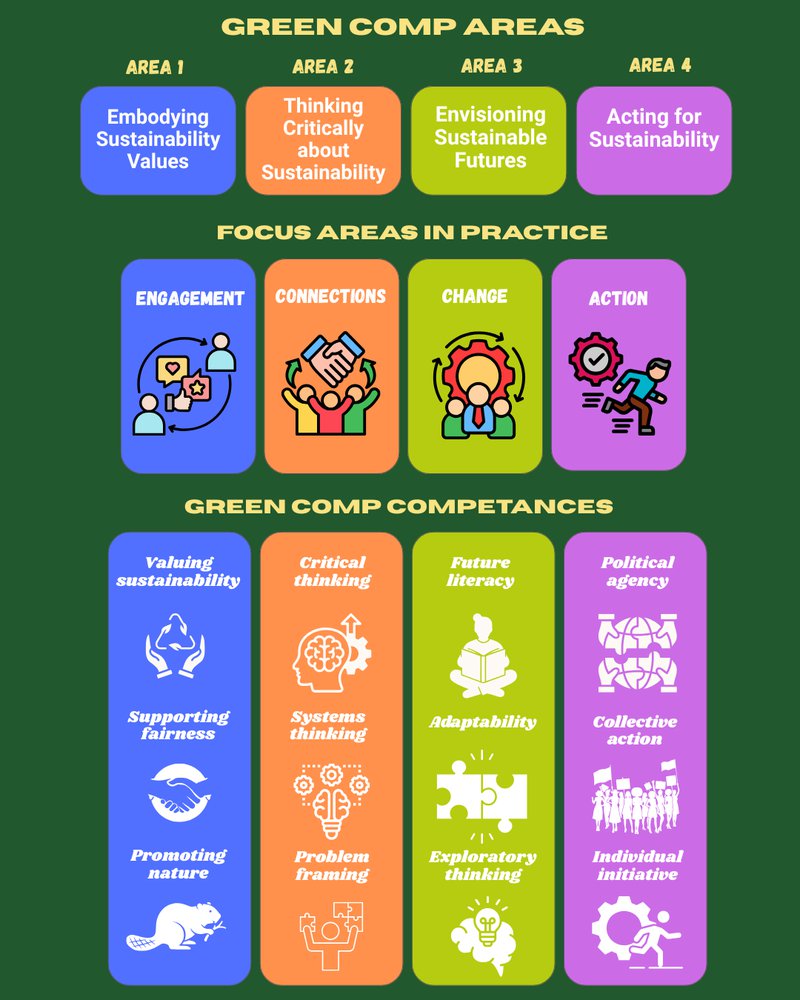
The first part lays the conceptual foundation, introducing “GreenComp” and the principles of teaching for sustainability. The second part explores sustainability values, inviting educators to reflect on how to embody them, think critically, and imagine sustainable futures. The third part focuses on taking action, providing concrete examples, activities, and tools that translate knowledge into practice.
By outlining the pedagogical principles that guide the EcoQuest 2 project, this Guide serves as both a foundation and an inspiration. It supports the development of innovative educational experiences such as the project’s video game and Live Action Role-Playing (LARP) game.
It strengthens educators’ capacity to promote environmental citizenship, critical thinking, and to foster engagement among young learners.
This Guide is divided into three interconnected parts, each designed to support educators throughout their sustainability teaching and awareness journey. The first part lays the conceptual foundation, introducing GreenComp and teaching for sustainability. Building on this groundwork, the second part delves deeper into sustainability values. It explores how to embody them, think critically (e.g., spotting greenwashing) and what future could we envision based on these keyed values. The third and last part focuses on acting for sustainability. It provides concrete examples of activities and tools to act for sustainability. By clearly defining the principles and objectives that guide the EcoQuest 2 project, this guide provides a solid pedagogical foundation for all deliverables. It supports the creation of more meaningful and impactful educational experiences and it serves as inspiration and references for the development of the EcoQuest 2 project’s own educational games (video game and LARP). Thus, strengthening educators’ understanding of environmental citizenship and critical thinking.
What is Green Comp?
Imagine you’re asked to integrate sustainability into your work. What does it mean? Does it involve recycling your paperwork, commuting by bike, encouraging students to adopt a vegetarian diet, or engaging in activism?
Or perhaps all of the above?
That’s what GreenComp is for.
GreenComp is a European reference framework that explains what sustainability as a competence actually means “and how it can be developed through the educational system” (JRC, 2022). In other words, it helps you move from “students should care about the planet” to “students can analyse systems, imagine alternative futures and take meaningful action together”. GreenComp is the response to “the growing need for people to improve and develop the knowledge, skills and attitudes to live, work and act in a sustainable manner”
(JRC, 2022). Many people want to act but feel stuck somewhere between information overload and a sense of powerlessness. Developed within the framework of the European Green Deal, this “catalyst” is here to promote strategies and fill the gap between theoretical knowledge and attitudes. It raises awareness of environmental challenges, encourages systems thinking and empowers both collective and individual actions.
GreenComp is basically a shared roadmap for “learning to live well on a “finite planet”, written in a language that teachers and youth workers can actually use. It turns big words like “sustainability” and “green transition” into concrete, teachable competences that you can build into lessons, projects and everyday practice.
Read more soon!